

Growing a business is exciting, but finding the right workplace can quickly become a challenge. Traditional office leasing often means large upfront investments, long-term commitments, furniture and equipment costs, utility bills, maintenance responsibilities, and months of preparation before a team can fully move in.
For startups, SMEs, and expanding companies, this can tie up valuable capital that could otherwise be invested in hiring, technology, sales, or product development.
This is where Managed Office Space offers a smarter alternative.
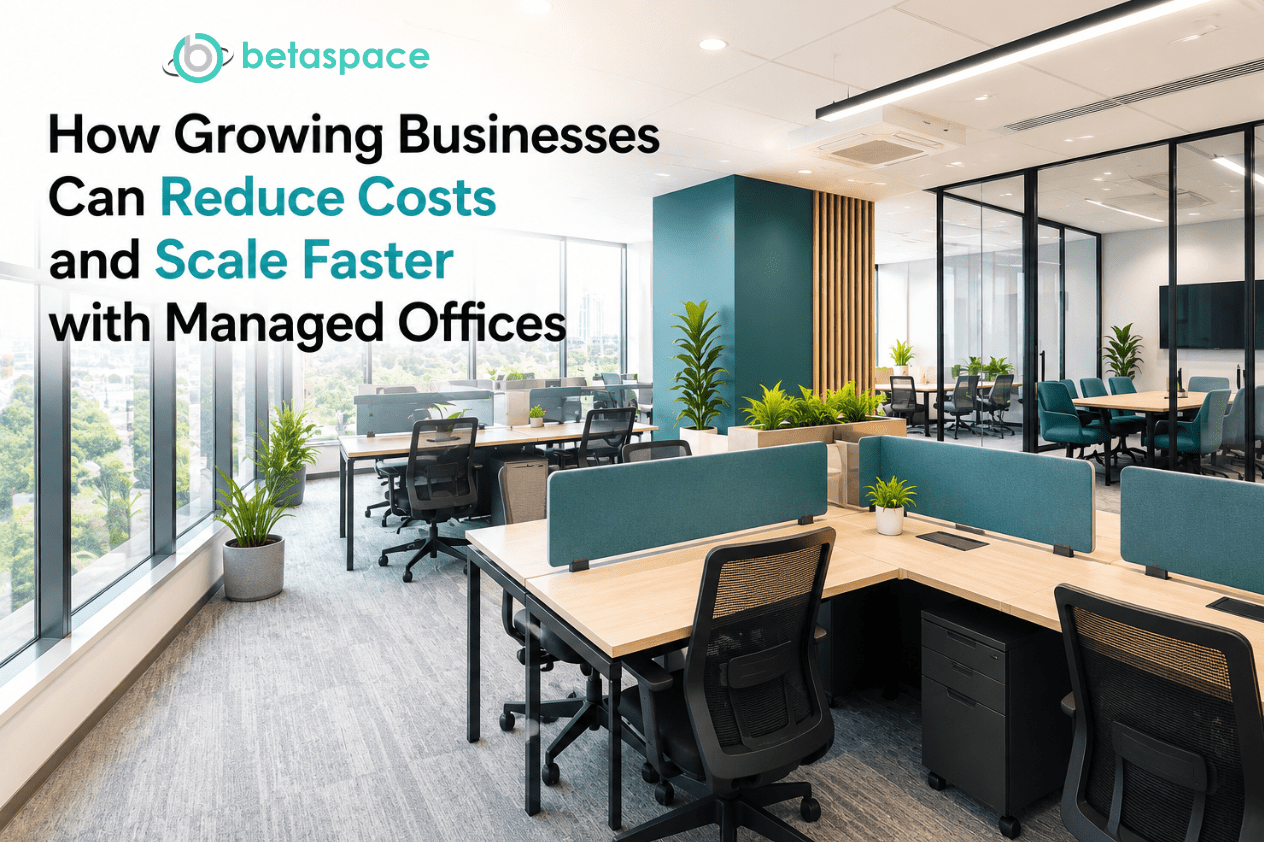
Managed offices combine a professional workplace with flexible agreements, ready-to-use infrastructure, technology, meeting facilities, and day-to-day operational support. Instead of building an office from scratch, businesses can move into a fully equipped environment and focus on what matters most: growing the company.
According to CBRE’s 2026 research, India’s flexible workspace sector is increasingly being used as a strategic tool for scalability, standardisation, and operational outsourcing—not simply as a lower-cost alternative to traditional offices.
What Is Managed Office Space?
Managed Office Space is a fully equipped workplace operated and managed by a workspace provider on behalf of a business.
Unlike a traditional lease, where the company is responsible for designing, furnishing, maintaining, and operating the office, a managed office provides many of these requirements as part of the workspace solution.
Depending on the provider, a managed office may include:
- Fully furnished workstations
- Private cabins and executive offices
- Meeting and conference rooms
- High-speed internet
- Reception and front-desk services
- Electricity and utilities
- Housekeeping and maintenance
- IT infrastructure
- Security
- Common areas
- Pantry facilities
- Business support services
This makes managed offices particularly attractive for companies that want a plug and play office space without spending months setting up their own premises.
Why Are Growing Businesses Looking for Office Space Solutions?
As a company grows, its workspace requirements change quickly.
A team that starts with 10 employees may need 30, 50, or 100 seats within a few years. Traditional office leases may not provide enough flexibility to accommodate this growth.
At the same time, businesses need to control operating costs.
The U.S. Small Business Administration recommends identifying and estimating startup expenses such as office space, equipment, utilities, communications, insurance, and other operational costs when planning a business.
A well-designed Office Space Solution can therefore help businesses convert several separate expenses into a more predictable workplace cost.
Common Problems With Traditional Office Leasing
Businesses setting up a conventional office may need to manage:
- Security deposits and advance rent
- Interior design and construction
- Furniture purchases
- Internet and networking
- Electricity and utilities
- IT infrastructure
- Housekeeping
- Repairs and maintenance
- Office administration
- Space planning
For a growing company, these responsibilities can consume significant management time.
How Managed Office Space Helps Reduce Costs
One of the biggest advantages of Managed Office Space for Growing Businesses is the potential to reduce the total cost and complexity of setting up and operating a workplace.
1. Lower Initial Investment
Setting up a traditional office can require substantial capital before the first employee even sits at a desk.
Furniture, interiors, electrical work, networking, meeting rooms, branding, security systems, and equipment can quickly increase the initial investment.
With a managed office, much of the infrastructure is already available.
This creates a Cost-Effective Office Space model where businesses can avoid or reduce large upfront setup expenses.
2. Predictable Monthly Expenses
Traditional offices often involve multiple recurring bills.
A managed office can consolidate many workplace-related expenses into a simpler monthly commercial arrangement.
This makes budgeting easier and gives business owners greater visibility into occupancy costs.
3. Less Spending on Office Infrastructure
Companies do not necessarily need to purchase desks, chairs, meeting-room furniture, networking equipment, or other workplace infrastructure from scratch.
The provider manages the physical workspace while the company concentrates on its core operations.
4. Reduced Administrative Work
Office management requires time.
From maintenance requests and housekeeping to utilities and workplace operations, there are numerous tasks that have little connection to revenue generation.
Managed Workspace Solutions transfer many of these responsibilities to the workspace operator.
5. Better Use of Capital
For startups and SMEs, capital is particularly valuable.
Instead of investing heavily in office infrastructure, businesses can allocate resources toward:
- Hiring
- Product development
- Marketing
- Technology
- Customer acquisition
- Business expansion
This is one reason Office Space for Startups and Office Space for SMEs increasingly includes flexible workplace models.
Managed Office Space vs Traditional Office Leasing
Choosing between traditional leasing and a managed office depends on the company’s size, budget, growth plans, and operational requirements.
| Feature | Traditional Office | Managed Office Space |
| Initial setup | Usually high | Usually lower |
| Furniture | Business arranges | Typically provided |
| Interior work | Business responsibility | Usually ready |
| Maintenance | Business responsibility | Provider-managed |
| Internet | Separate arrangement | Often included |
| Flexibility | Generally limited | Higher |
| Scalability | Can be difficult | Easier |
| Move-in time | Weeks or months | Often much faster |
| Meeting facilities | Requires investment | Usually available |
| Administrative workload | Higher | Lower |
The important point is not simply to compare monthly rent. Businesses should evaluate the total cost of occupancy, including fit-out, furniture, utilities, maintenance, administration, and the value of flexibility.
CBRE’s workplace research similarly notes that flexible office pricing should be evaluated against the broader costs included in the arrangement rather than comparing it only with a traditional rental rate.
How Managed Office Solutions Help Businesses Scale Faster
Growth rarely happens in a perfectly predictable pattern.
A company might need 20 seats today and 40 seats next year. Another business may need a temporary project office for six months before expanding into a larger location.
This is where Scalable Office Space becomes valuable.
Flexible Expansion
A flexible workspace can allow businesses to increase their occupied space as their teams grow, subject to availability and the provider’s terms.
Instead of relocating every time the workforce increases, companies can explore additional cabins, workstations, or suites within the same workspace environment.
Flexible Workspace Solutions for Different Business Stages
Different businesses require different workplace models.
| Business Stage | Suitable Workspace |
| Freelancer | Hot desk or shared workspace |
| Early-stage startup | Private office or small managed office |
| Growing SME | Dedicated managed office |
| Mid-sized company | Larger private office suite |
| Enterprise team | Custom corporate office space |
| Temporary project team | Flexible office space |
This makes Flexible Workspace for Businesses useful across multiple stages of growth.
Key Benefits of Fully Managed Office Space
Plug-and-Play Convenience
A Plug and Play Office Space allows businesses to move into an operational workplace without managing every element of the setup process.
Professional Business Environment
A well-designed workplace creates a professional environment for employees, clients, partners, and visitors.
Private and Secure Working Areas
Companies that require confidentiality can choose Private Office Space rather than an open shared environment.
Private offices are particularly useful for management teams, consultants, financial services companies, legal professionals, technology teams, and businesses handling sensitive information.
Meeting and Collaboration Facilities
Modern businesses need more than desks.
Meeting rooms, conference facilities, collaboration areas, breakout spaces, and presentation rooms can support internal meetings and client interactions without requiring businesses to build every facility themselves.
Professional Image
A premium Business Office Space can support brand perception when clients or partners visit the workplace.
For companies that are still building their identity, a professional workspace can provide the infrastructure and environment expected by larger clients.
Managed Office Space for Startups and SMEs
Startups often need flexibility because their growth trajectory is uncertain.
An early-stage company may not want to sign a long traditional lease, invest heavily in interiors, and then discover that its requirements have changed six months later.
Similarly, SMEs may need additional space when hiring new employees, entering a new market, or launching a new project.
Managed Office Space for Growing Businesses provides an opportunity to match workplace capacity more closely with business requirements.
For example:
10 employees → 20 employees → 40 employees → 80 employees
Instead of treating every stage as a completely new office project, businesses can plan their workspace strategy around growth.
Managed Office Space vs Serviced Office Space
The terms Managed Office Space and Serviced Office Space are sometimes used interchangeably, but the exact offering can vary by provider.
Generally, serviced offices focus on ready-to-use office facilities and shared services, while managed offices can provide a more customised workplace experience tailored to the company’s requirements.
Businesses should compare:
- Privacy
- Branding options
- Contract flexibility
- IT infrastructure
- Number of seats
- Meeting facilities
- Support services
- Expansion options
- Pricing structure
The right solution depends on the company’s operational needs rather than the label used to describe the workspace.
Practical Tips for Choosing the Right Managed Office
1. Calculate Your Total Workspace Cost
Do not compare only the advertised monthly price.
Consider:
Rent + utilities + furniture + internet + maintenance + cleaning + meeting rooms + setup costs + administration
A slightly higher monthly price may still be more economical if significantly more services are included.
2. Plan for Future Growth
Estimate your expected headcount for the next 12–24 months.
Choosing a workspace that cannot accommodate growth could create unnecessary relocation costs.
3. Check Contract Flexibility
Understand:
- Minimum commitment
- Renewal terms
- Expansion options
- Exit clauses
- Additional seat pricing
- Deposit requirements
4. Evaluate Location
Consider accessibility for employees and clients.
A convenient location can support recruitment, employee satisfaction, client meetings, and business credibility.
5. Inspect Infrastructure
Before signing, check:
- Internet reliability
- Power backup
- Meeting rooms
- Security
- Air conditioning
- Furniture quality
- IT support
- Housekeeping
- Parking
- Common areas
6. Look Beyond the Desk
The best Flexible Workspace Solutions should support how your team actually works.
Consider whether the workplace offers enough private areas, meeting rooms, collaborative spaces, and quiet zones for your business.
Who Can Benefit From Managed Office Solutions?
Managed offices can be suitable for:
- Startups
- SMEs
- Technology companies
- Consulting firms
- Agencies
- Financial services businesses
- Remote-first companies needing a physical base
- Corporate project teams
- Expanding regional teams
- Companies entering a new city
- Businesses testing a new market
For companies that need Affordable Office Space without sacrificing professionalism, managed workspaces can provide a practical middle ground between coworking and traditional leasing.
Why Flexible Workspace Is Becoming a Strategic Business Choice
The flexible workspace market is evolving beyond the traditional concept of coworking.
CBRE’s 2026 India research describes flexible workspace as increasingly important for scalability, standardisation, operational outsourcing, and corporate real-estate strategy.
CBRE’s 2025 India Office Occupier Survey also found that 72% of surveyed occupiers expected to expand their office portfolio by 10% or more over the following two years, highlighting the importance of workplace strategies that can accommodate expansion.
For growing companies, this means office space is no longer simply a physical location. It can become a strategic tool for managing costs, supporting employees, and responding quickly to business changes.
Why Choose BetaSpace for Managed Office Space in Coimbatore?
Businesses looking for a Managed Office Space in Coimbatore can consider BetaSpace for flexible workplace solutions designed around modern business requirements.
A managed workspace approach can help businesses access professional offices, private work environments, meeting facilities, and workplace infrastructure without handling every aspect of traditional office setup themselves.
For companies planning their next stage of growth, the right workspace can provide the flexibility to start efficiently and expand with confidence.
Final Thoughts: Choose an Office That Grows With Your Business
The best office space is not necessarily the largest or the cheapest. It is the one that fits your current requirements while giving your business room to adapt.
Managed Office Space provides a practical solution for businesses that want professional infrastructure, reduced setup complexity, flexible workplace options, and the ability to scale without repeatedly rebuilding their office environment.
For startups, SMEs, and growing companies, Managed Office Solutions can turn office management from a time-consuming responsibility into a more predictable and scalable business function.
Instead of spending valuable time building an office, businesses can focus on building the business itself.